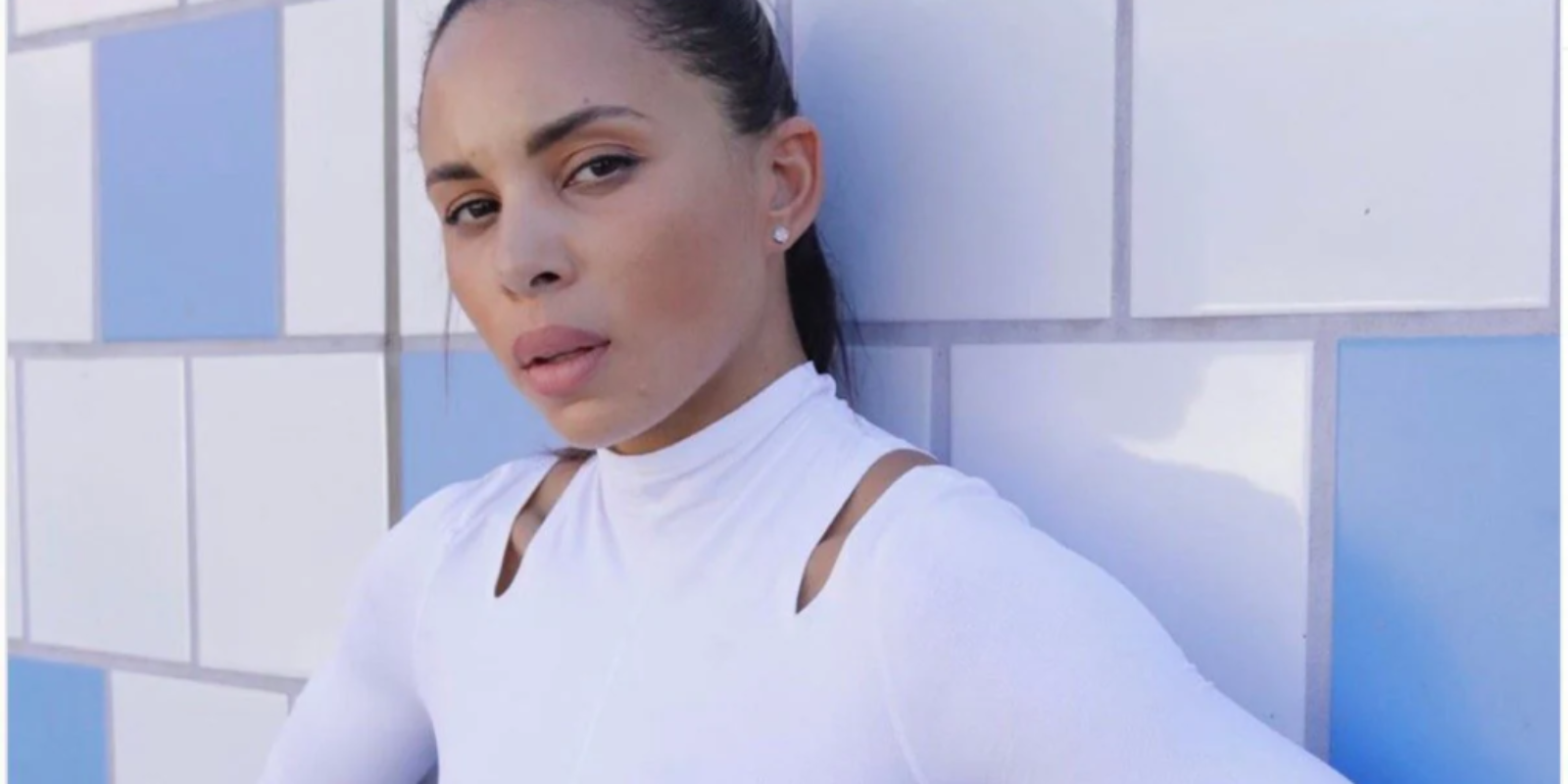
Meet Louise Hazel
Former Olympic heptathlete, Louise Hazel, was an integral part of Team GB and won Commonwealth gold before retiring in 2013. Louise now lives and works in LA, training Hollywood clients through her female-focused gym, Slay, on Hollywood Boulevard.
When she’s not training or putting high profile clients through their paces, Louise is also a podcast host, TV presenter, and racial equality advocate. This summer she published an open letter to the fitness industry, signed by 120 professional women of colour who work within it, to address racial inequality and representation within the industry. As part of this, Louise put together The Playbook, featuring guidance and solutions as to how inequality can be addressed in all areas of the industry, from the working environment to hiring.
Extracts taken from the transcript of the podcast recording
FD [00:02:16]I went to Nike HQ in Amsterdam to talk to the staff there about communications and wellbeing. And I looked at this idea of comparing learnings in life to becoming an athlete and how athletes train and they have coaches and support to get them to where they need to be. Yet as, as human beings, we plod through life sometimes without ever asking for help. And I think the comparisons for me have always been a really nice, easy one to kind of align yourself with, you know, asking for help, building a network around you and support. [80.9s]
FD [00:11:14]During that time, Louise, did you have quite a lot of support from your family, the people around, to enable you to kind of do all of that training? [10.5s]
LH [00:11:25]My biggest support was my father. I can say this hand on heart that I would not have made it to Olympic level or even Commonwealth level without the support of my family. And on a daily basis, that basically look like them showing up, taking me training. Originally it was twice a week that then soon escalated into five times a week. And because we lived in a very rural area in a town called March in Cambridgeshire, the nearest 400 metre track was 30 minutes away. And so it was a commitment. When I’m speaking to young athletes and I’m talking to their parents, I’m always expressing how important it is for them to be actively active participants in their lives, and in their sporting careers, no matter how far it takes them. [91.3s]
LH [00:18:24]The interesting thing is, Kevin, I wouldn’t say it’s always been that way. I’d say in the first part of my career, up until I retired from school, my mind and body was very much in tune. You know, there’s no way you can make it to the Olympic Games without this mental dexterity, the ability to adapt and, you know, the mental fortitude and also the physical fortitude that you come to rely on as an elite athlete. And so turning up mentally and showing up physically was always an easy thing for me to do. It’s just in my nature. And so it felt like I was always expressing myself and always aligned with where it was always supposed to go. You know, when I look at my friends growing up, they would often be hanging around at the bus shelter in the evenings, you know, just doing kid stuff. And I never had an interest in that. I was always drawn like a magnet to sport because I knew that it was my destiny and I was on an altogether different path and I never really strayed from that. You know, I might go out to a club one night, get a little bit too drunk, and I’d still have to get up and hurdle the next morning, which always made for a good training session. But it wasn’t until very recently, especially after I retired from athletics, that I discovered the alignment of the heart. And really, in fact, in the past two years, I would say because it’s that been the first time that I’ve allowed the space for emotion and to connect with myself emotionally. Because as an athlete, it’s almost emotion is almost drilled out of you. You simply have to turn up and get the job done. No matter what is going on in your life, no matter how. Feeling that day. You never get to really check in with yourself in the morning and say, You know what? I feel like I’m having a bit of an off day. You don’t get the chance because every day is a normal day. Every day is a measure of, the best that you can be. So there’s definitely in my life and journey as a human being, this being this real path and journey to surrendering, especially over the past two years. And I’d say that I’ve started to live with my heart more open, much more open to the possibilities of who I can become and stepping away from what I’ve already achieved to kind of develop all of my life skills. [138.3s]
FD [00:22:32]And is music part of your spiritual practice, Louise? [3.0s]
LH [00:22:36]Absolutely. I can remember the song that I was listening to. It was Sunshine, I think it was by Labrinth, and this is back in 2010. This is a song that I listened to in the warm up prior to going out and winning the gold medal Commonwealth Games. And so there were these moments, I think in sport where music is just linked in, it’s inextricably linked. There’s a rhythm and a pace and a vibration to it. And I remember it being so hot in Delhi and, you know, there was these stories of, you know, is the stadium going to stay up and is the track finished in time? And so you didn’t quite know what was going to be going on with regards to the organisation of the competition. And I remember the lyrics of the song where, you know, Let the Sun Shine and I was like, Yeah, let that sun shine. I’m like, I’m ready for it. Let’s go. It’s today. And then I can remember my 200 metres in London 2012, standing on the top and ready to close out the first day of competition, which again had been a rollercoaster. I had a terrible high jump, a decent hurdles, a good shotput and the 200 was the event where, you know, I tend to pick up points and I can remember Katy Perry singing, firework. I remember singing it and also being on the screen and singing it and hearing, you know, the 80,000 people in the in the audience singing it with me. And I’m like, yeah, I’m a firework. I’m about to show you all that kind of amazing. But yeah, like, music has always been there. It will continue to be there in my life. And also, you know, in the major sporting events that come. [99.6s]
FD [00:24:16]Having read some of your recent interviews as well, and obviously following you on Instagram, you’ve been a big advocate this year for bringing people together and also raising the vibrations of inclusivity and making sure that people are held responsible. Can you talk a little bit about your playbook? [20.3s]
LH [00:24:39]Yes. So the playbook came around as a result of an open letter that I penned to the fitness industry. And I said we can’t talk about this without mentioning the people that lost their lives this year here in the US, George Floyd, Breonna Taylor, Ahmaud Arbery, amongst a whole heap of other people just facing these just extreme stream injustices due to the systemic violence and also racism that exists within policing and the system. And so, you know, everybody was moved to action this year. And so I felt that it was the right time to unveil the way that especially women of colour feel walking into an environment in the fitness industry, which is predominantly male and predominately white. So the playbook was a result of our open letter. An open letter led to 120 women sitting down and discussing what the main issues were in terms of representation within the fitness industry, in terms of inequality in the fitness industry. And the playbook essentially became the new set of rules. So this was established by myself and a number of conversations with people of colour and basically just stating, you know what, these are the new rules of engagement and these are the new standards that we’re going to live by and we’re going to set. I feel like it’s now actually a time for unity and bringing people together and say, you know, this is how we work together. This is how we move forward together. And if you work in entertainment, if you’re an agent, if you work in marketing, then these are the some of the things that you might need to consider. And if there are certain things that you’re not sure about, come and ask us. It’s an open door policy. We all want things to be better. [143.2s]
LH [00:30:04]Yes. So 18 months ago and I basically built a gym in Hollywood. And it was a really interesting thing. You know, obviously, I moved to Los Angeles for the purpose of television work and also it being the centre of the world of fitness. I was like, you know what? I need to be in the midst of it. It’s a personal training studio, so the type of clients we have come in are often actors, actresses, writers, producers, directors, and it’s basically just been a hub and a hive for, you know, some of the most creative and inspirational people I’ve ever met in my life. And I basically teach them and with other trainers, teach them how to unleash their inner athlete. Once they first walked through the door and you tell them, Oh, I’ve seen you before, you’re an athlete, they don’t believe you. But after three or four weeks or months of work, then suddenly they start to see this natural athleticism emerge that they didn’t necessarily believe was there. [57.8s]
LH [00:31:10]I mean, I’ve always really had a little bit of a head for business, even when I was competing in track and field for London 2012, I actually lost my funding. My father passed in 2008, which left me completely and literally pulled the rug from beneath my feet. So I was actually in my final year of university, so doing my finals, I just had a few exams left to sit. 2008 would have been a long shot, but it could have been my first ever Olympic Games and my father passed earlier on in the year in May so 2008 was very much a write-off. My dad was 50 years old. He suffered a heart attack and then later passed away in hospital after he contracted a superbug. And so, you know, it was literally within my world that was flipped upside down within months. And I was kind of left there with the pieces, figuring out how to put it all back together. Because I underperformed in 2008, I lost my lottery funding. Yeah. And, you know, the reality of it is the politics of sport does not stop. No, it doesn’t stop to support you. It just keeps going. [72.3s]
February 8, 2023 @ 11:19 am
I follow Louise on Instagram and love her story but I hadn’t heard her say lots of this before. It’s such a great interview format. I keep thinking what does becoming more human means to me… not yet decided.
Keep up the good work!